
AI answer
Fixing shopify-checkout" class="blog-glossary-link">Shopify checkout errors in Melbourne requires a surgical audit of the Checkout Extensibility layer. Most errors are caused by unoptimized app-scripts or third-party pixel latency. I provide 24h technical triage to recover lost sales and stabilize checkout infrastructure.
Shopify Checkout is the conversion-critical flow where a customer moves from intent to payment confirmation. When that flow stalls, fails, or feels unreliable, stores do not just lose one order. They lose trust, attribution accuracy, and confidence in every paid traffic dollar landing on the site. For Melbourne businesses running paid acquisition, seasonal retail campaigns, or high-margin ecommerce, checkout reliability is not a cosmetic concern. It is operational infrastructure.
The most common mistake I see is treating checkout failure like a generic theme issue. In reality, many of these incidents sit inside the interaction between Shopify’s Checkout Extensibility model, third-party scripts, payment gateways, and shipping logic. If a merchant has migrated part of the store to newer extension-based patterns while still relying on older assumptions from checkout.liquid-era customisation, the result is often a brittle conversion path that only breaks under specific products, customer locations, or payment methods.
That is why a specialist approach matters. A real checkout triage does not begin with random app removals. It begins with reproduction, instrumentation, and narrowing the failure boundary: what product types fail, what shipping destinations trigger the issue, whether the delay occurs before the payment request, during a gateway callback, or after the order attempt returns. Once that path is clear, remediation becomes precise instead of expensive guesswork.
What Checkout Extensibility means in practice#
Checkout Extensibility is Shopify’s current model for controlled customisation of checkout through approved extensions, functions, and app surfaces. It exists to improve security, consistency, and upgrade safety. But it also changes how engineers must reason about failures. If a merchant or agency still expects direct checkout template manipulation to behave like legacy setups, they can end up layering fragile logic around a modern extension stack.
In practical terms, I audit whether checkout functionality belongs in supported extensions, app blocks, Shopify Functions, or a separate service altogether. I look for overlap between discount logic, shipping calculations, analytics pixels, fraud tooling, and payment-side integrations. When too many systems compete to influence the same moment in the checkout lifecycle, errors become intermittent and therefore harder for internal teams to explain.
API Latency and why it kills conversion#
API Latency is the delay introduced while checkout waits for another service to respond. That could be a payment gateway, a tax engine, a shipping-rate provider, a fraud tool, or a merchant’s custom backend. The customer does not care where the delay sits. They only experience a button that feels dead, a spinner that lasts too long, or a payment step that appears broken.
For Melbourne retail and Australian ecommerce, this becomes more painful when stores depend on combinations such as Stripe, Openpay, custom ERP syncs, postcode-sensitive shipping logic, and multiple analytics or remarketing pixels. Each dependency might be acceptable alone. Together, they can create serial waiting, race conditions, or inconsistent state updates. The result is often higher abandonment on mobile, especially when network quality is variable and the checkout already carries too much script weight.
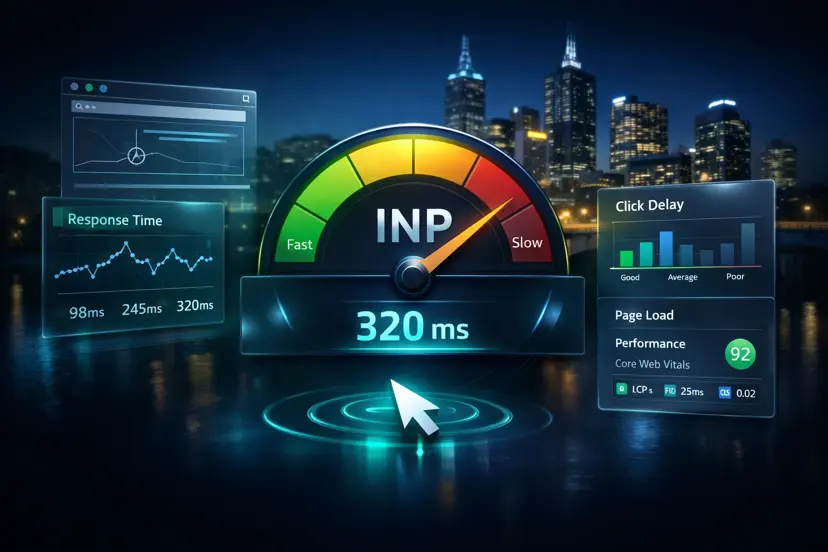
This is where responsiveness metrics matter. A poor checkout INP score usually means the interface cannot respond quickly after a user taps, types, or changes an option. That is not an abstract performance number. In checkout, poor responsiveness looks exactly like distrust. Users assume payment did not work or the page is frozen, and they leave.
The Melbourne triage model I use for checkout errors#
My process starts with a controlled reproduction matrix. I test checkout against the product combinations, shipping zones, currencies, and payment methods most likely to fail. For Melbourne stores, that often means checking postcode-specific shipping behaviour, GST handling, payment methods like Stripe or Openpay, and edge cases triggered by local delivery logic or mixed cart rules.
- Reproduce the exact failure path: identify the specific checkout stage where users drop off or receive inconsistent results.
- Audit script and extension load: isolate app scripts, pixels, and custom tags that compete for checkout execution or event timing.
- Validate payment gateway behaviour: inspect callback timing, payment intent failures, and retry flows for Stripe, Openpay, or other providers.
- Check shipping and currency logic: confirm rate selection, postcode mapping, free-shipping thresholds, and currency formatting paths.
- Measure responsiveness: identify long tasks, delayed interactions, and extension rendering overhead that damage perceived reliability.
- Stabilize and verify: remove the conflict source, retest the checkout path, and confirm the fix across real customer scenarios.
High-friction errors I see most often#
The highest-value issues are rarely the loudest ones. Some stores show a visible error message. Others just experience silent leakage: the cart reaches checkout, but payment options load slowly, shipping becomes inconsistent, or the interface feels unstable enough that users abandon. Common causes include duplicated scripts, extension conflicts, stale discount logic, currency formatting mismatches, and event handlers that fire too late on mobile.
I also see stores where abandoned cart data becomes noisy because tracking tags and checkout transitions are not aligned. That creates a second-order problem: the merchant cannot trust the data well enough to know whether the root issue is conversion, attribution, or platform instability. Fixing checkout means restoring both the transaction path and the integrity of the signals around it.
Why general agency support usually misses it#
Large agencies often approach checkout issues through account management workflows, not technical isolation. That can be fine for routine theme updates, but it is too slow for high-dropoff payment incidents. By the time a merchant has sent videos, waited for support handoffs, and received generic advice to disable apps one by one, the store has already lost days of revenue.
A specialist workflow is narrower and faster. The goal is not to produce a long deck. The goal is to stop the leak, document the conflict, and give the merchant a stable checkout path with clear next actions. When needed, I also map which issues belong to Shopify-native configuration, which belong to third-party providers, and which belong to custom engineering debt introduced over time.
What to do if your checkout is leaking sales#
If your Shopify store is showing rising dropoff, payment failures, odd postcode behaviour, slow checkout interaction, or inconsistent currency display, do not assume the problem will self-correct. Checkout problems compound quickly because every campaign, every returning user, and every email flow keeps feeding customers into the same unstable path.
The fastest route is a 24-hour triage focused on the failing path, not a general site review. If you need that in Melbourne, start with Website Fixes or contact PKTechie with the store URL, affected payment methods, shipping scenarios, and any screenshots or recordings from the failed checkout. That gives me enough context to isolate the technical break point quickly and move toward a verified fix.